Devon · EX10
Drone surveys in Sidmouth, flown by the surveyor who writes them
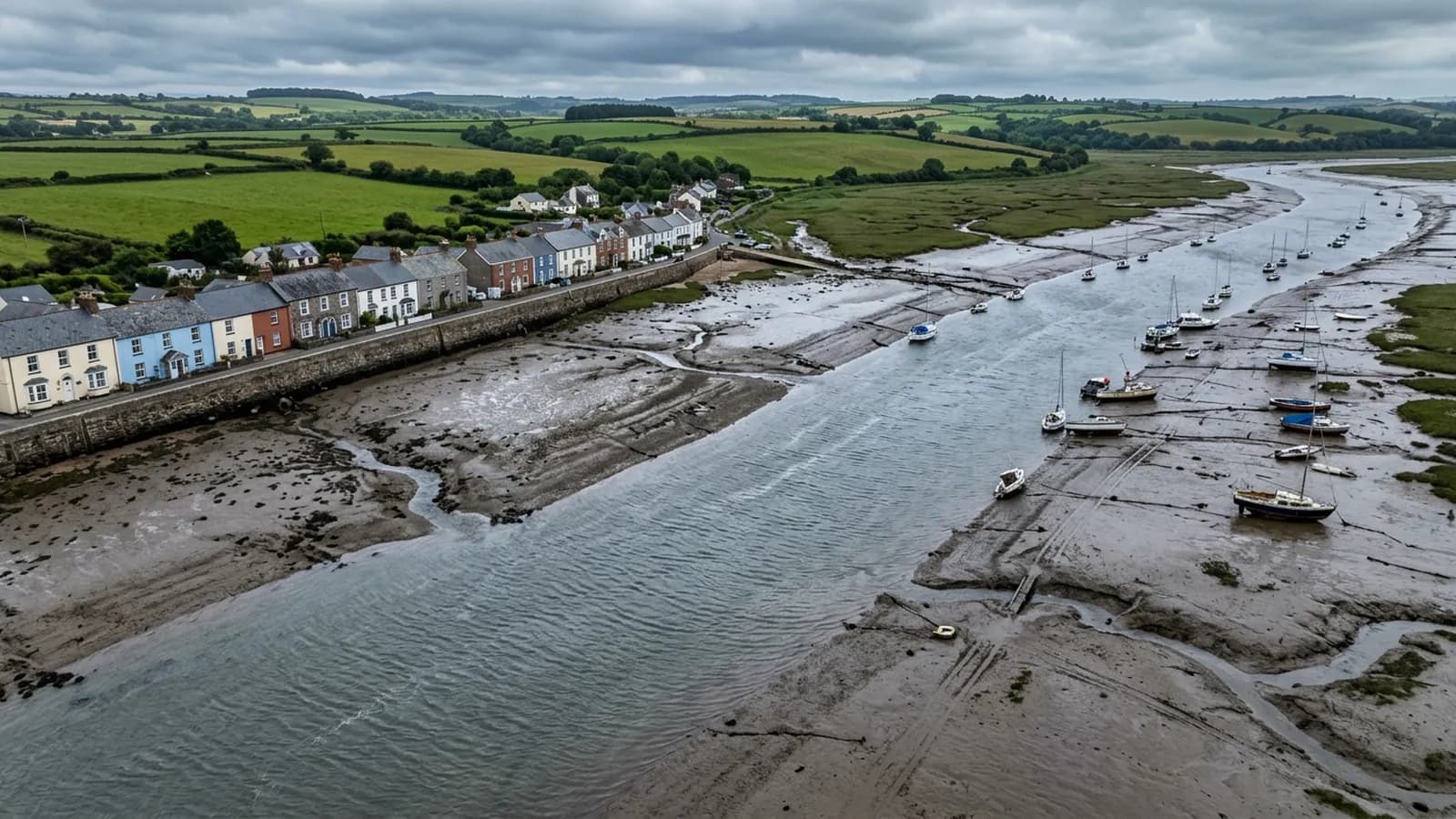
About forty minutes from Exeter. A Regency town in a steep valley, where hills either side funnel wind and make the air round chimneys turbulent.
A survey town, if ever there was one
Sidmouth has an unusually complete Regency and early Victorian core: rendered and painted elevations, ornate ironwork, and complex roof geometries with lead lined valleys and parapet gutters running between them. It is, from a surveying point of view, one of the most interesting towns in Devon and one of the hardest to inspect by any traditional means.
Complex geometry is the phrase doing the work there. A Regency roof of this type is rarely one plane. It is several, meeting at valleys, hidden behind parapets, drained through concealed gutters, and finished with lead that has been repaired repeatedly. Every one of those junctions is a potential failure and none of them can be seen from the esplanade.
Parapet gutters and lead lined valleys
These two details account for a large share of what goes wrong on the town's older buildings, and they share a characteristic: when they fail, water goes inside the building rather than off it. A blocked parapet gutter backs up over the wall head. A split in a lead lined valley discharges directly into the structure between two roof planes.
From the air both are readable. Standing water and debris in a parapet gutter show as a dark line with a tide mark. Lead that has crept or split shows as a break in what should be a continuous run, and the staining below it usually confirms the story. Photographed close, they give a builder something to price from rather than something to investigate.
Around the outlying villages there is thatch, and there is clay plain tile through the town alongside the natural slate. The lead detailing is what makes Sidmouth distinctive though, and it is what the survey concentrates on.
The valley effect
The town sits in a steep sided valley at the mouth of the Sid, hemmed in by Peak Hill to the west and Salcombe Hill to the east, both rising well over 150 metres. The valley funnels wind off the sea straight up the town, and the steep hills either side create turbulent, gusting conditions around ridges and chimneys.
That has two consequences. For the buildings, chimney stacks and ridge lines in a turbulent flow take loading from directions and at intervals that a steady wind would never produce, which is hard on mortar bedding and on tall stacks. For the flying, it means an aircraft near a ridge here is in air that changes without warning, so surveys are flown with more clearance and in calmer conditions than the same job would need on flat ground.
Salt reaches the esplanade properties hard. Those are the ones where fixings, ironwork and any galvanised detail get looked at specifically, and where the difference between a front rank building and one three streets back is obvious in the imagery.
Getting there, and choosing the day
The drive is about forty minutes from Exeter, over the top and down into the valley. The town is compact enough that a survey of one building rarely needs more than a morning, and complex enough that it usually needs the whole of one.
Given the turbulence, the day matters more here than the hour. A calm winter morning after a dry spell gives clean imagery of lead and stone; a gusty afternoon gives a set of frames taken while the aircraft was working hard, and the difference shows.
Behind the survey
What Sidmouth clients are actually buying
Registered with the CAA
A registered operator with both an Operator ID and a Flyer ID. The Operator ID is the one that has to be displayed on the aircraft, and it is the number a client or an insurer asks for.
A2 Certificate of Competency
The A2 CofC is the theory and self-practical qualification that sits above the basic Flyer ID test. There is no GVC, which is stated here rather than left out, because it changes how some sites have to be planned.
Insured with Coverdrone
Commercial cover through Coverdrone, one of the specialist drone insurers. A copy of the certificate goes out on request before a booking, not after it.
DJI Mavic 4 Pro
The main survey aircraft. A 100 megapixel Hasselblad camera and 6K video, which is what lets a photograph of a ridge from twenty metres away still show an open mortar joint.
DJI Mavic 2 Enterprise Advanced
The thermal aircraft. A 640 by 512 radiometric thermal camera alongside the visual one, so a heat pattern can be read against the picture of the same elevation.
Construction background
The surveying came after years of contracting, so the report is written by somebody who has stood on the scaffold as well as flown over it, and who knows which faults matter and which are cosmetic.
Written report within 48 hours
A process commitment, not a sales promise. The flight is the short part of the job; the report is where the time goes, and it lands within two days of the visit.
No scaffolding, no ladders
Nothing leans on the building and nobody goes up it. That removes the access cost, the permit paperwork and the working-at-height risk from the survey itself.
Nearby
Also covered around Sidmouth
- Budleigh SaltertonAround twenty five minutes from Exeter. Substantial detached houses in generous plots, long held and lightly altered, with thatch on the outskirts.
- Ottery St MaryAbout half an hour from Exeter. An inland valley town where mist and damp let moss establish fast on shaded slopes, with cob and thatch in the lanes.
- HonitonThirty five minutes from Exeter. A uniform Georgian high street rebuilt after fires, in a valley whose sitting fog keeps roofs damp all winter.
See the credentials
Talk to a surveyor in Sidmouth
Send the address and what is worrying you. Sam Hembury will come back with a fixed price and the next slot that suits the weather.