Devon · TQ12
Drone surveys in Newton Abbot, flown by the surveyor who writes them
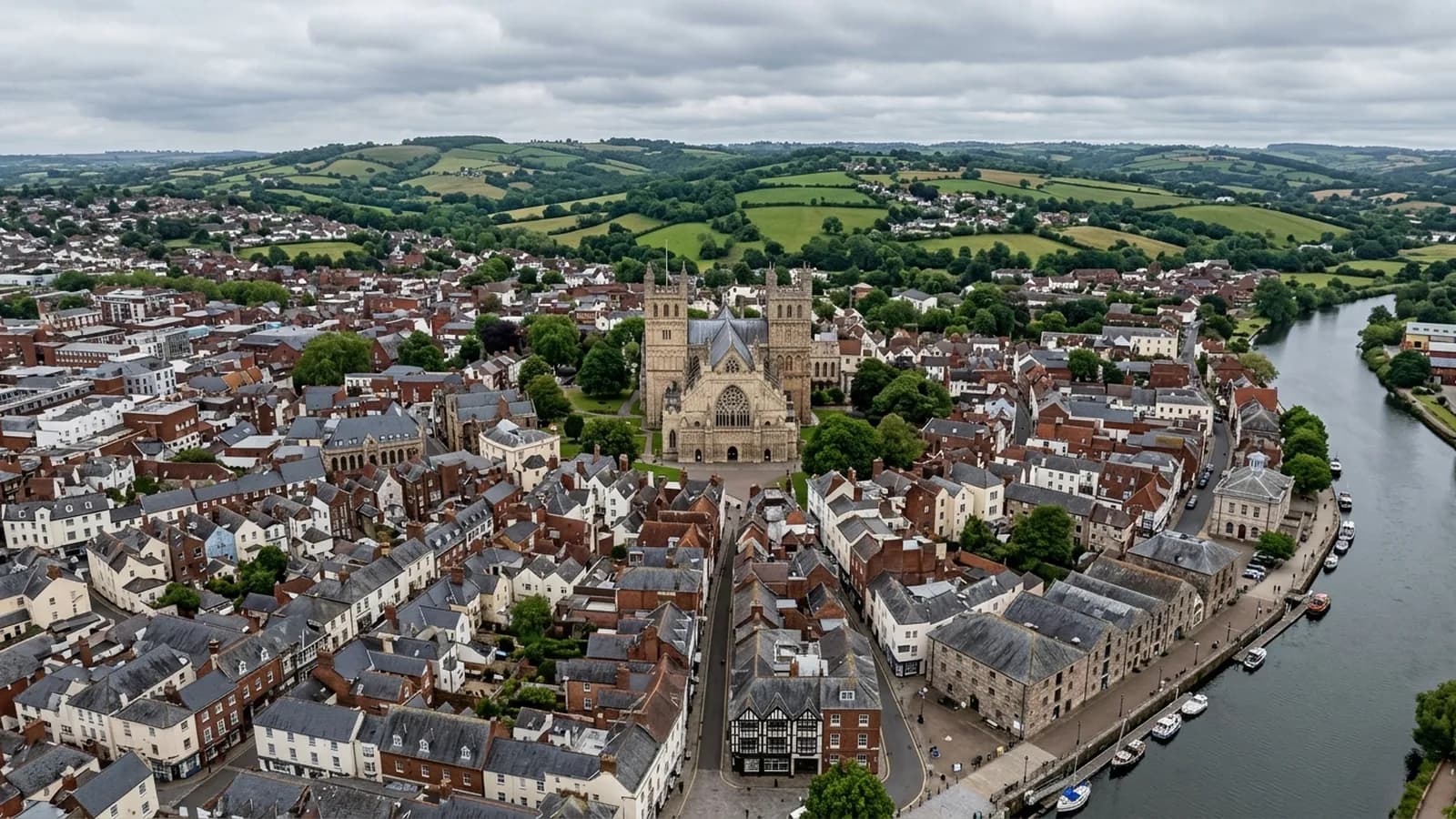
About half an hour from Exeter. A flat floodplain town of railway-era terraces and trading estate roofs, where mist off the Teign keeps shaded slate green.
Half an hour, and a town that repays a whole visit
Newton Abbot sits about half an hour from Exeter down the A380, which puts it comfortably inside a morning. The town has enough terraced housing of one period, and enough large span commercial roofing on its trading estates, that a visit here often covers more than one address for whoever manages a group of properties.
The racecourse, the estuary and the Bovey basin clay workings sit around the edges, and the ground between them is flat, which is unusual for this part of Devon and makes launch points easy to find. It is one of the more straightforward towns on this list to plan a flight in.
A town the railway built, and the roofs to match
Victorian railway-era terraces exist here in large numbers and they were built in a hurry to a pattern. That is useful. When a hundred houses went up the same way in the same decade, they tend to fail the same way in the same decade, so a fault found on one is worth checking for on the rest of the row.
The ornate town centre of the same period brings a different problem: decorative parapets, deep cornices and hidden gutters behind them. Those parapet gutters are the classic invisible defect. They sit above the ceiling of a shop or an office, they fill with grit and leaf litter over years, and nobody looks in them because there is no way to look in them from the ground.
Beyond that come extensive post-war estates on concrete interlocking tile, substantial modern development at Houghton Barton and Wolborough where the questions are usually about workmanship rather than age, and the trading estates with their large span roofs, rooflights and long parapet runs.
Damp air, and the green that comes with it
The town sits on the flat floodplain where the Teign becomes tidal, ringed by hills, and mist off the river is a regular feature. Low lying and damp is exactly the recipe for organic growth, and shaded slate here holds moss and lichen readily.
That matters more than it sounds. Moss on an exposed slope is a nuisance. Moss in a valley or behind a parapet is a dam, and a dammed valley on a Victorian terrace pushes water sideways under the slates and into the party wall. On a Newton Abbot survey the valleys and the hidden gutters get looked into specifically, not just photographed in passing.
The town is less wind exposed than the coast, but the estuary funnels easterlies through in winter, which is the direction most of the older detailing was never designed for. Easterly driven rain finds the gaps that thirty years of south westerlies never touched.
Industrial roofs and what shows from above
The large span roofs on the trading estates are their own category of survey. Profiled sheet with rows of rooflights, long parapet gutters and roof mounted plant, all of it invisible from the yard below. What shows from the air is the whole system at once: which rooflights have gone milky and brittle, where a fixing line has worked loose, whether the gutters are running or standing, and whether the plant has been sitting on the covering long enough to mark it.
For anybody managing one of those units, that overview is usually the point. A roofer quoting off a ladder sees one corner. A single set of aerial frames covers the lot and gives a basis for deciding whether this is a repair year or a replacement conversation.
Behind the survey
What Newton Abbot clients are actually buying
Registered with the CAA
A registered operator with both an Operator ID and a Flyer ID. The Operator ID is the one that has to be displayed on the aircraft, and it is the number a client or an insurer asks for.
A2 Certificate of Competency
The A2 CofC is the theory and self-practical qualification that sits above the basic Flyer ID test. There is no GVC, which is stated here rather than left out, because it changes how some sites have to be planned.
Insured with Coverdrone
Commercial cover through Coverdrone, one of the specialist drone insurers. A copy of the certificate goes out on request before a booking, not after it.
DJI Mavic 4 Pro
The main survey aircraft. A 100 megapixel Hasselblad camera and 6K video, which is what lets a photograph of a ridge from twenty metres away still show an open mortar joint.
DJI Mavic 2 Enterprise Advanced
The thermal aircraft. A 640 by 512 radiometric thermal camera alongside the visual one, so a heat pattern can be read against the picture of the same elevation.
Construction background
The surveying came after years of contracting, so the report is written by somebody who has stood on the scaffold as well as flown over it, and who knows which faults matter and which are cosmetic.
Written report within 48 hours
A process commitment, not a sales promise. The flight is the short part of the job; the report is where the time goes, and it lands within two days of the visit.
No scaffolding, no ladders
Nothing leans on the building and nobody goes up it. That removes the access cost, the permit paperwork and the working-at-height risk from the survey itself.
Nearby
Also covered around Newton Abbot
- TeignmouthAbout half an hour from Exeter. A seafront town that catches easterly gales, which finds the details built only for south westerly weather.
- TorquayAbout forty minutes from Exeter. Seven limestone hills, and Italianate villas whose elaborate roofscapes cannot be seen from the street at all.
- TotnesAbout forty five minutes from Exeter. A steep medieval hill town on the Dart, packed with hidden valleys and party wall abutments.
- ExeterThe base town, ten minutes away. The constraint in Exeter is other people rather than distance: dense roofscapes, student blocks, city airspace.
- DawlishHalf an hour from Exeter, among the most storm exposed places on this coast, where cliff top bungalows take unbroken wind at ridge and verge.
See the credentials
Talk to a surveyor in Newton Abbot
Send the address and what is worrying you. Sam Hembury will come back with a fixed price and the next slot that suits the weather.