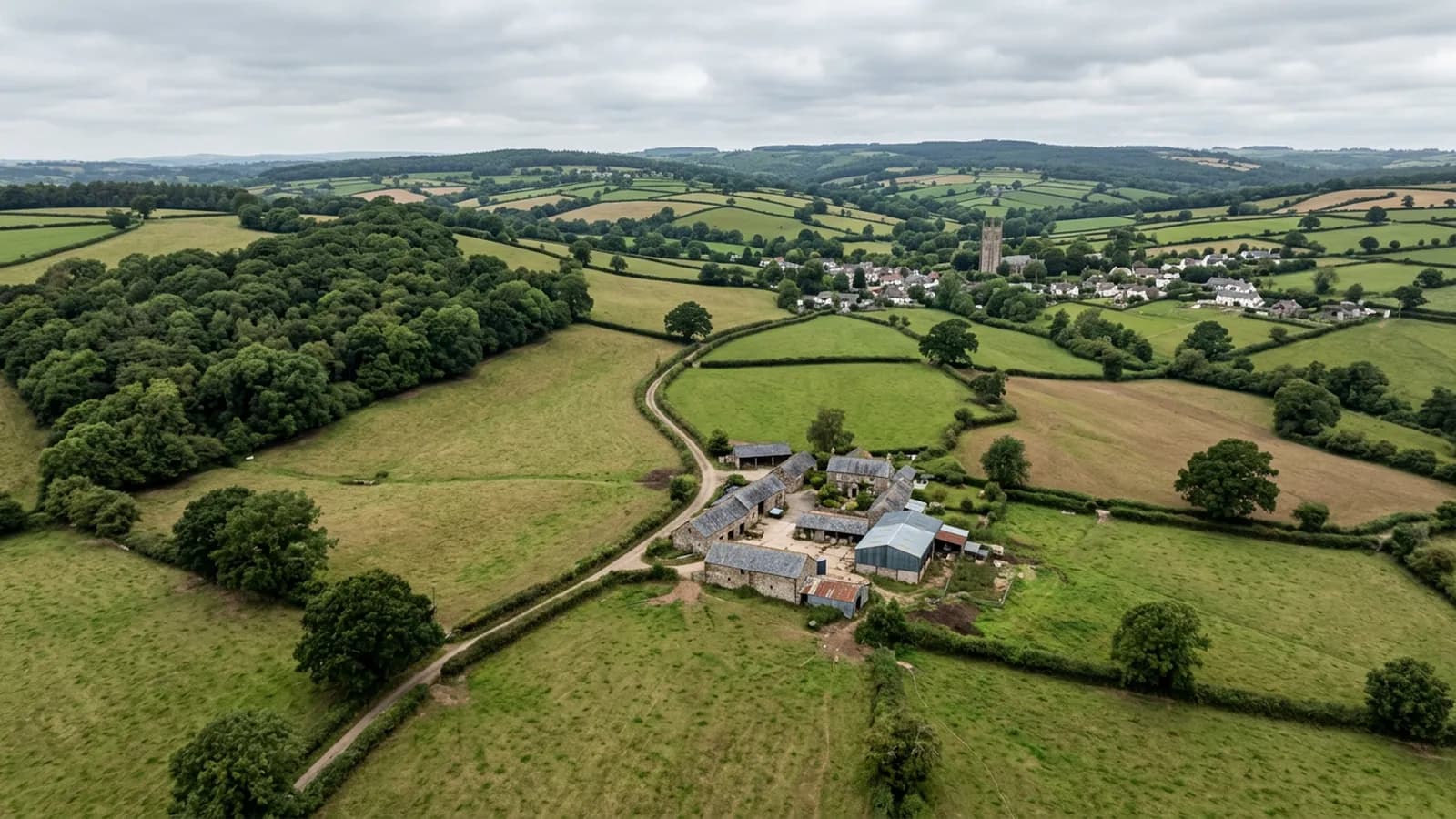
Devon · EX14
Drone surveys in Honiton, flown by the surveyor who writes them
Thirty five minutes from Exeter. A uniform Georgian high street rebuilt after fires, in a valley whose sitting fog keeps roofs damp all winter.
A high street built all at once
Honiton is about thirty five minutes from Exeter on the A30. Its long high street was rebuilt after eighteenth century fires and is famously uniform as a result, with Victorian additions behind and post-war and modern estates to the north and west.
A street rebuilt in one campaign is a gift to a surveyor. The buildings share a construction date, a roof pitch, a covering and a drainage arrangement, so a defect found on one is worth checking for along the row, and a comparison between neighbours is a fair comparison rather than an apples and pears exercise.
Long terraces and what happens behind them
The characteristic problem on a continuous terraced frontage is what happens at the back and in between. Rear slopes drop into shared yards, valleys run between properties in different ownership, and rainwater from one roof passes across or beside another before it reaches a drain.
None of that is visible from the high street, and much of it is not visible from any single owner's property. A flight covering a run of buildings shows the whole system at once, which is what somebody dealing with a persistent damp problem in a party wall actually needs.
Coverings are natural slate and clay plain tile in the town, thatch on outlying cottages, and concrete tile on the modern estates. Plain tile is worth a note: it is a small unit with a double lap, it relies on the nibs and the battens, and when a batten softens the tiles slip in ones and twos over years rather than all at once.
Fog that sits
The town is sheltered from the sea but exposed to weather coming over the Blackdowns, and the valley is prone to sitting fog that keeps roofs damp through the winter months. Sitting fog is an underrated agent of decay. It does not run off, it does not dry quickly, and it keeps a surface at a moisture level where organic growth thrives and mortar stays saturated.
The practical consequence for a survey is that a Honiton roof can look far worse in February than the same roof looks in July, and neither view is wrong. If a decision about money is going to be made from the report, the end of winter is when the evidence is most useful.
For a flight, sitting fog is simply a reason to reschedule. Visual line of sight is not negotiable and the imagery from a foggy morning is worthless anyway.
The Blackdowns behind
Dumpdon Hill and the Blackdown Hills rise steeply to the north and east, and the outlying properties up towards them are a different survey from the ones on the high street: detached, exposed, often thatched, and standing in wind that the town itself never feels.
Where a job is out of the town and up on the hills, the wind check matters and the local forecast is the one to trust. Where it is on the high street, the constraint is people and parked cars rather than weather.
Behind the survey
What Honiton clients are actually buying
Registered with the CAA
A registered operator with both an Operator ID and a Flyer ID. The Operator ID is the one that has to be displayed on the aircraft, and it is the number a client or an insurer asks for.
A2 Certificate of Competency
The A2 CofC is the theory and self-practical qualification that sits above the basic Flyer ID test. There is no GVC, which is stated here rather than left out, because it changes how some sites have to be planned.
Insured with Coverdrone
Commercial cover through Coverdrone, one of the specialist drone insurers. A copy of the certificate goes out on request before a booking, not after it.
DJI Mavic 4 Pro
The main survey aircraft. A 100 megapixel Hasselblad camera and 6K video, which is what lets a photograph of a ridge from twenty metres away still show an open mortar joint.
DJI Mavic 2 Enterprise Advanced
The thermal aircraft. A 640 by 512 radiometric thermal camera alongside the visual one, so a heat pattern can be read against the picture of the same elevation.
Construction background
The surveying came after years of contracting, so the report is written by somebody who has stood on the scaffold as well as flown over it, and who knows which faults matter and which are cosmetic.
Written report within 48 hours
A process commitment, not a sales promise. The flight is the short part of the job; the report is where the time goes, and it lands within two days of the visit.
No scaffolding, no ladders
Nothing leans on the building and nobody goes up it. That removes the access cost, the permit paperwork and the working-at-height risk from the survey itself.
Nearby
Also covered around Honiton
- Ottery St MaryAbout half an hour from Exeter. An inland valley town where mist and damp let moss establish fast on shaded slopes, with cob and thatch in the lanes.
- AxminsterAbout fifty minutes from Exeter. A hilltop town near the Dorset border, open to wind from every quarter, with large span former industrial roofs.
- CullomptonTwenty five minutes up the M5. A Culm valley town of medieval fabric, thatch and modern estates, on ground that holds damp and frost.
- SidmouthAbout forty minutes from Exeter. A Regency town in a steep valley, where hills either side funnel wind and make the air round chimneys turbulent.
See the credentials
Talk to a surveyor in Honiton
Send the address and what is worrying you. Sam Hembury will come back with a fixed price and the next slot that suits the weather.